The air fryer is the most returned countertop appliance in America, and the reason is almost always size: too small for the household that bought it, or too large for the counter that hosts it. The technology itself is simple — a fan and a heating element — so the differences between models come down to capacity, shape, and the features that either earn their place or collect grease. This guide covers what actually matters, from the team that uses one daily.
Capacity: The Number That Decides Everything
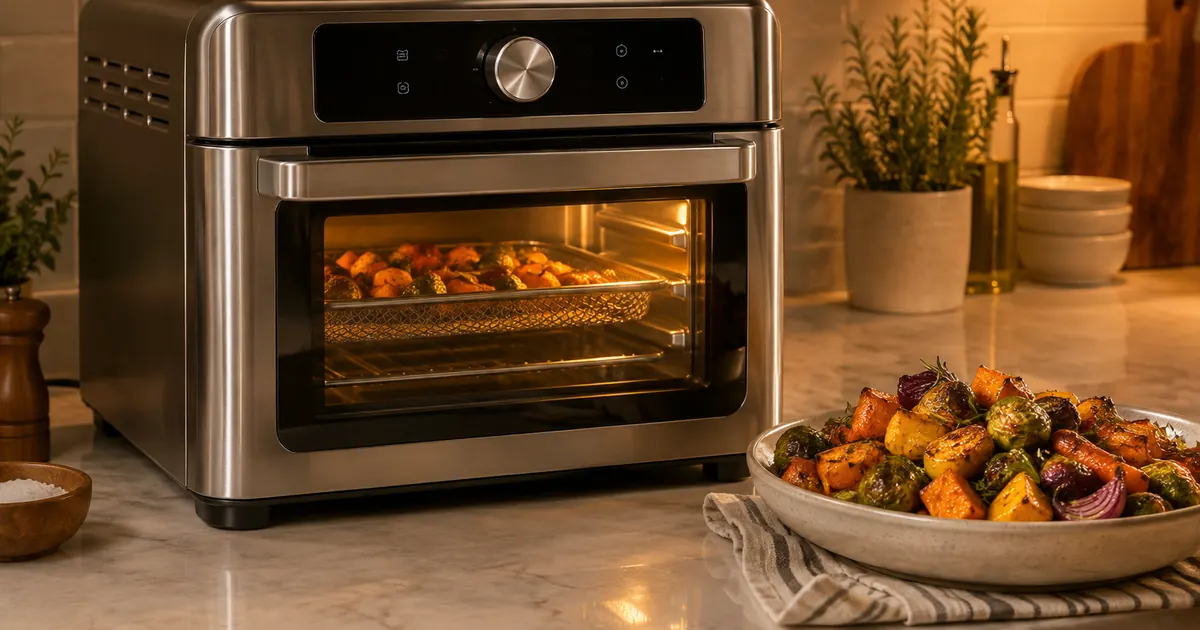
Air fryer capacity is quoted in quarts, and the honest translation is people per meal. Two to three quarts suits one person or a couple cooking sides. Five to six quarts is the family size — four servings of protein or a full tray of vegetables. The 6-Qt Air Fryer Oven sits in the sweet spot: a whole chicken, four salmon fillets, or two pounds of wings in one pass, in a stainless body that does not dominate the counter.
The two-person trap
The most common mistake is buying small because a household is small. Air fryers earn their place by replacing the oven for side dishes and weeknight proteins — and leftovers are half the value. A 6-quart that cooks tonight's dinner and tomorrow's lunch beats a 3-quart that cooks one meal at a time.
Basket vs Oven: The Shape Question
Basket models are the classic: pull, shake, return. They heat fastest and clean easiest. Oven models — like ours — add a door, a tray, and usually more capacity, which suits families and anyone who bakes or roasts alongside the air-fry function. The honest trade: baskets are faster and more fun; ovens are more versatile and hold more. Choose by what you cook most — wings favor the basket, sheet-pan meals favor the oven.
Wattage and Preheat: The Speed Math
Wattage is heating speed. Under 1,000 watts preheats slowly and struggles with thick cuts; 1,500 to 1,700 watts is the modern standard and preheats in about three minutes. The difference sounds minor until the air fryer becomes a weeknight tool — three minutes of preheat is the difference between using it daily and thinking about it while the oven slowly wins.
Features That Earn Their Place
- Dishwasher-safe basket or trays: the single best feature. If cleanup needs hand-scrubbing, usage drops within a month.
- A real temperature range (180°F–400°F): low settings dehydrate and reheat gently; high settings crisp.
- A see-through window and interior light: checking food without opening keeps the heat in and the cook honest.
- A timer that remembers: presets are marketing; a timer that holds your last setting is the feature you will actually use.
The Hype to Ignore
Digital touchscreens add nothing a dial cannot. Sixteen presets are a menu of the same temperature at different names. Wi-Fi connectivity solves a problem nobody has — preheating remotely still requires food in the basket. And "oil-free" claims deserve context: the air fryer uses a teaspoon where a deep fryer uses a quart, which is the entire health story, and it needs no marketing to be true.
What an Air Fryer Actually Replaces
The value math, from our own kitchen: it replaces the oven for reheating pizza (better than any method), roasting vegetables (faster, crispier), cooking frozen staples, and weeknight proteins. It does not replace the oven for baking bread or hosting. Households that understand this split use the fryer daily; households that expected a full oven replacement feel disappointed by a tool doing its actual job well.
The First Week: Cooking It In
An air fryer earns trust through a first-week gauntlet, and the order matters. Night one: frozen fries — the machine's party trick and the calibration point every owner shares. Night three: chicken thighs, skin down, at 380 for eighteen minutes. Night five: roasted vegetables tossed with a teaspoon of oil. By the second week the temperature-and-time intuition is yours, and the oven becomes the secondary appliance for everything except baking and hosting. The 6-Qt oven handles all three tests without reheating the kitchen.
Reheating: The Underrated Superpower
The air fryer's most frequent job in most homes is reheating, and it is genuinely the best at it: pizza regains its crisp in three minutes at 350, fried anything returns to something like its first hour, and last night's roast re-crisps while the microwave would have steamed it. Households that discover this use the machine more for leftovers than for cooking from scratch — and that is not a failure of ambition; it is the tool finding its real job.
Our Kitchen & Dining collection holds the 6-quart oven we use daily alongside the boards, cookware, and kettles that share its counter — with free US shipping, tax-free pricing, and 30-day returns, because the only real test is a month of Tuesday dinners.